


Grants
906
FY 2020 Grants for Buses and Bus Facilities Project Selections Notice
Federal Register Notice in which the U.S. Department of Transportation’s (DOT) Federal Transit Administration (FTA) announces the allocation of $463,848,929 to projects under the Fiscal Year (FY) 2020 Grants for Buses and Bus Facilities Program (Bus and Bus...
FTA-Sponsored Technical Assistance, Training, and Research Resource Programs
OverviewFTA’s Technical Assistance and Workforce Development Program (49 U.S.C. § 5314) and the Public Transportation Innovation Program (49 U.S.C. § 5312) fund technical assistance, training, and research resource programs through national nonprofit organizations across a number of areas to...
Fiscal Year 2020 Buses and Bus Facilities Projects
State Project Sponsor Project Description Funding Amount AK Fairbanks North Star Borough Fairbanks North Star Borough in Alaska will receive funding to complete construction of the second phase of a project to replace its current transit facility,...Pilot Program for Transit-Oriented Development Planning – Section 20005(b)
What's New
- On May 11, 2026, FTA announced approximately $28.5 million in available funding for the Fiscal Year 2026 Pilot Program for Transit-Oriented Development Planning Program. Applications are due by 07/10/2026.
- On June 10th, FTA hosted a webinar for this funding opportunity that included an overview of the program, eligibility requirements, and NOFO evaluation criteria.
- View the presentation
- Watch the recording (Passcode: ^&sxDUT0)
- Responses to audience questions will be published soon
- On June 10th, FTA hosted a webinar for this funding opportunity that included an overview of the program, eligibility requirements, and NOFO evaluation criteria.
Overview
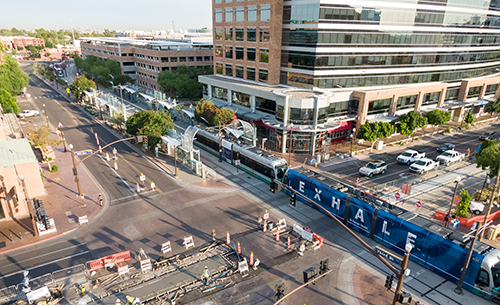
The Pilot Program for TOD Planning helps support FTA’s mission of improving America’s communities through public transportation by providing funding to local communities to integrate land use and transportation planning with a new fixed guideway or core capacity transit capital investment. (Learn more about transit-oriented development (TOD).) Comprehensive planning funded through the program must examine ways to improve economic development and ridership, foster multimodal connectivity and accessibility, improve transit access for pedestrian and bicycle traffic, engage the private sector, identify infrastructure needs, and enable mixed-use development near transit stations.
For TOD projects advancing to design and construction, the Build America Bureau offers financial assistance for TOD implementation through the Transportation Infrastructure Finance and Innovation Act and Railroad Rehabilitation and Improvement Financing credit assistance programs. In partnership with the Bureau, FTA will conduct oversight of certain TOD projects to ensure compliance with federal requirements, while the Bureau will provide technical assistance for potential borrowers.
TOD Project Dashboard
FTA launched a TOD Planning Program GIS dashboard that showcases information on awarded proposals and the respective planning studies. To navigate the user-friendly tool, simply click on a dot on the map and learn more about the project. For questions about this tool, contact April McLean-McCoy.
Selected Projects
Grants for Buses and Bus Facilities Program
What's New
- On July 27, 2026, FTA announced the availability of $610 million under the FY26 Notice of Funding Opportunity for the Grants for Buses and Bus Facilities Infrastructure Programs, which include the Grants for Buses and Bus Facilities Program and the Low or No Emission Program. Applications are due by September 21, 2026.
- Of this, approximately $21 million in funding is authorized under the Grants for Buses and Bus Facilities Program.
- View a recorded webinar and presentation slides on this NOFO, including an overview of program eligibility, evaluation criteria, selection considerations, and the application package.
- Watch the Applying for FTA Grant Opportunities on Grants.gov recording.
- On February 20, 2026, FTA announced approximately $390 million in Grants for Buses and Bus Facilities project selections, supporting 34 projects in 19 states and Puerto Rico.
- Read the press release
- View the Selections and Implementation Guidance for FY26 Bus
- On November 20, 2025, FTA announced approximately $2 billion in Grants for Buses and Facilities and Low or No Emission project selections, supporting 165 projects in 45 states and the District of Columbia.
- Read the press release
- View the Selections and Implementation Guidance for FY25 Bus and FY25–26 Low-No
Overview
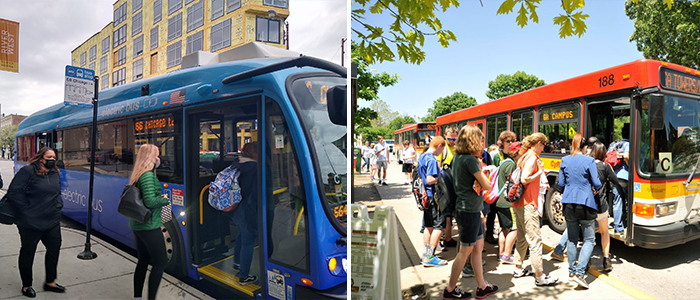
The Grants for Buses and Bus Facilities Competitive Program (49 U.S.C. 5339(b)) makes federal resources available to states and direct recipients to replace, rehabilitate and purchase buses and related equipment and to construct bus-related facilities, including technological changes or innovations to modify low or no emission vehicles or facilities. Funding is provided through formula allocations and competitive grants.
Allocation of Funding
Funding is allocated to projects on a competitive basis, from proposals submitted to FTA in response to a Notice of Funding Opportunity (NOFO). Past project selections include:
Eligible Recipients
Eligible applicants for the Buses and Bus Facilities Program include designated recipients that allocate funds to fixed-route bus operators, states (including territories and Washington D.C.) or local governmental entities that operate fixed route bus service, and Indian tribes.
Eligible subrecipients include all otherwise eligible applicants and also private nonprofit organizations engaged in public transportation.
Eligible Activities
Capital projects to replace, rehabilitate and purchase buses, vans, and related equipment, and to construct bus-related facilities, including technological changes or innovations to modify low or no emission vehicles or facilities. Additionally, 0.5% of a request may be for workforce development training, and an additional 0.5% may be for training at the National Transit Institute. Applicants proposing any project related to zero-emission vehicles must also spend 5% of their award on workforce development and training as outlined in their Zero-Emission Transition Plan, unless the applicant certifies that their financial need is less.
Statutory References
49 U.S.C. Section 5339(b), IIJA § 30018
Funding Availability
Funds remain available for obligation for four fiscal years. This includes the fiscal year in which the amount is made available or appropriated plus three additional years.
Match
The federal share of eligible capital costs is 80 percent of the net capital project cost, unless the grant recipient requests a lower percentage. The Federal share may exceed 80 percent for certain projects related to the ADA and the Clean Air Act. All low-no emission projects are attributable to compliance with the Clean Air Act and/or the Americans with Disabilities Act. Therefore, the Federal share of the cost of leasing or purchasing a low or no emission transit bus is not to exceed 85 percent of the total transit bus cost. The federal share in the cost of leasing or acquiring low- or no-emission bus-related equipment and facilities is 90 percent of the net project cost. Applicants must identify these specific activities in their application in order to receive this increased federal share.
Resources
Tribal Transit Formula Grants (Section 5311(c)(1)(B))
Overview
The Public Transportation on Indian Reservations Program, also referred to as Tribal Transit Program (TTP), provides funds for planning, public transportation capital projects, operating costs, job access reverse commute projects, and the acquisition of public transportation service to tribes located in rural areas (those with a population under 50,000). TTP is funded as a takedown from the Section 5311 program, and is a set-aside from the Formula Grants for Rural Areas program that includes a formula program and a competitive grant program.
Federal public transportation law (49 U.S.C. 5311(c)(1)(B)) and Infrastructure Investment and Jobs Act (IIJA) Section 300076, authorizes the formula amount of TTP for Fiscal Years (FY) 2022-2026.
Tribal Transportation Self-Governance Program
The Tribal Transportation Self-Governance Program (TTSGP) provides federally recognized tribes and tribal organizations with greater control, flexibility, and decision-making authority over DOT funds used to carry out tribal transportation programs, functions, services, and activities (PFSAs) in tribal communities.
The TTSGP also affords tribes and tribal organizations with specific rights and federal resources to implement and support their Self-Governance program. Learn more about TTSGP.
Funding Availability and Allocation
Five percent of Rural Formula (Section 5311) funding is available for the Public Transportation on Indian Reservations program. 20 percent of the Public Transportation on Indian Reservations funds must be distributed on a competitive basis, while the remainder must be apportioned by formula.
FTA apportions TTP formula funds to Indian tribes using a statutory formula based on the latest U.S. Census data and information reported by the National Transit Database (NTD). In order to receive formula funds, a tribe must report to the NTD on an annual basis.
The three tiers under the formula include:
- Tier 1: 50 percent of the available funds are apportioned based on vehicle revenue miles;
- Tier 2: 25 percent of the available funds are apportioned among Indian tribes providing at least two hundred thousand annual vehicle revenue miles; and
- Tier 3: 25 percent of the available funds are apportioned among Indian tribes providing public transportation on tribal lands where more than one thousand low-income persons reside.
Apportionments
- FY 2025: $37,555,590
- FY 2024: $37,952,037
- FY 2023: $36,413,211
View current or archived apportionments to access detailed information.
Eligible Recipients
Eligible recipients are federally recognized American Indian or Alaska Native tribes as identified by the U.S. Department of the Interior (DOI) Bureau of Indian Affairs (BIA). However, tribes which are not federally recognized remain eligible to apply to the state as a subrecipient for funding under the state's apportionment.
Eligible Activities
Federally recognized tribes may use the funding for capital, operating, planning, and administrative expenses for public transit projects that meet the growing needs of rural tribal communities.
Examples of eligible activities include: capital projects; operating costs of equipment and facilities for use in public transportation; and the acquisition of public transportation services, including service agreements with private providers of public transportation services.
Match
There is no local match required under the formula program.
Additional Information
Coordination with Federal Programs
FTA’s TTP allows grantees to coordinate and assist in regularly providing meal delivery service for homebound individuals, if the delivery service does not conflict with providing public transportation service or reduce service to public transportation passengers. Learn more about the Coordinating Council on Access and Mobility (CCAM).
FTA Regional Tribal Liaisons
Federal Transit Administration's Regional Tribal Liaisons
Technical Assistance
The Transportation Technical Assistance Coordination Library (TACL) provides a sustainable methodology and platform to access resources across a diverse range of transportation technical assistance centers and FTA.
For additional technical assistance information and resources, visit the FTA-Sponsored Technical Assistance, Training, and Research Resource Programs webpage.
Passenger Ferry Grant Program - Section 5307
What's New
- On August 21, 2026, FTA announced approximately $665 million in Fiscal Year 2026 project selections to 23 projects in 14 states and U.S. Virgin Islands to improve and expand ferry service in communities across the country to help people connect to jobs and opportunity.
- Funding includes:
- $103.5 million under the Passenger Ferry Grant Program to eight projects in six states and the U.S. Virgin Islands.
- $454 million under the Ferry Service for Rural Communities Program to ten projects in four states.
- $107.3 million under the Low or No Emitting Ferry Program to five projects in five states.
- Funding includes:
Overview
One of FTA’s three ferry programs, the Passenger Ferry Grant program provides competitive funding for projects that support passenger ferry systems in urbanized areas. These funds constitute a core investment in the enhancement and revitalization of public ferry systems in the nation’s urbanized areas. Funds are awarded based on factors such as the age and condition of existing ferry boats, terminals and related infrastructure; benefits to riders, such as increased reliability; project readiness; and connectivity to other modes of transportation.
Eligible Recipients
Funding is made available to designated recipients and eligible direct recipients of Section 5307 funds, States and federally recognized Tribes that operate a public ferry system in an urbanized area.
Eligible Activities
Eligible activities are capital projects to purchase, replace, or rehabilitate passenger ferries, terminals, and related facilities and equipment. Funds may not be used for operating expenses, planning, or preventive maintenance.
Match
The federal share is not to exceed 80 percent of the net project cost for capital expenditures. However, the Federal share of the cost of leasing or purchasing a ferry that is compliant with the Clean Air Act (CAA) or the Americans with Disabilities Act (ADA) is not to exceed 85 percent of the total ferry cost. The federal share in the cost of leasing or acquiring compliant ferry-related equipment and facilities is 90 percent of the net project cost. Applicants must identify these specific activities in their application in order to receive this increased federal share.
Statutory Reference
49 U.S.C. 5307
Selected Projects
Additional Resources
Innovative Coordinated Access and Mobility Pilot Program
What's New
- On July 9, 2026, FTA announced approximately $12 million in available funding for the Fiscal Year 2026 Innovative Coordinated Access and Mobility (ICAM) Pilot Program. Applications are due by September 9, 2026. Please see the news release here.
- View the webinar presentation.
- Watch the informational webinar recording.
- Watch the Applying for FTA Grant Opportunities on Grants.gov recording.
Overview
The Innovative Coordinated Access and Mobility (ICAM) Pilot Program seeks to improve access to public transportation by building partnerships among health, transportation and other service providers. This program provides competitive funding to support innovative projects for transportation disadvantaged populations that will improve the coordination of transportation services and non-emergency medical transportation services.
Section 3006(b) of the Fixing America’s Surface Transportation (FAST) Act (Pub. L. 114-94, Dec. 4, 2015) authorizes FTA to award grants for the ICAM Pilot Program for transportation disadvantaged populations that improve the coordination of transportation services and non-emergency medical transportation services.
Funding Availability and Allocation
There is no minimum or maximum grant award amount; however, FTA funds as many meritorious projects as possible. Due to funding limitations, projects selected for funding may receive less than the amount requested. In those cases, applicants must be able to demonstrate that the proposed projects are still viable and can be completed with the amount awarded.
Grantees will have up to 24 months from the time of the award to complete the project. Within the first year, projects must be able to demonstrate impacts related to the expected outcome as described in the application. Funds under the ICAM Pilot Program may be used for capital expenditures only.
Project Selections
- FY 2023-2024: $7,833,610
- FY 2021: $8,404,279
- FY 2020: $3,502,820
FY 2018: $9,601,981
FY 2016: $7,211,518
Eligible Recipients
Eligible applicants are organizations that are eligible to be recipients and subrecipients of the Enhanced Mobility of Seniors and Individuals with Disabilities Program, (defined under 49 U.S.C. 5310):
- Designated recipients
- States and local governmental authorities
- Private nonprofit organizations
- Operators of public transportation
Proposals may contain projects to be implemented by the recipient or its subrecipients.
Eligible Activities
The ICAM Pilot Program awards funds competitively to finance innovative capital projects for the transportation disadvantaged populations that improve the coordination of non-emergency medical transportation services.
Match
The maximum federal share of project costs under the ICAM Pilot Program is 80 percent. The applicant provides a local share of at least 20 percent of the net project cost and must document the source of the local match in the grant application.
Eligible local-match sources include:
- Cash from non-government sources other than revenues from providing public Transportation services;
- Revenues derived from the sale of advertising and concessions;
- Revenues generated from value capture financing mechanisms;
- Funds from an undistributed cash surplus;
- Replacement or depreciation cash fund or reserve;
- New capital; or
- In-kind contributions.
In addition, the applicant may use transportation development credits for local match.
Additional Information
Grantee Final Reports
Section 3006(b) of the Fixing America’s Surface Transportation Act requires that: The Secretary shall make publicly available an annual report on the pilot program carried out under this subsection for each fiscal year...The report shall include a detailed description of the activities carried out under the pilot program and an evaluation of the program, including an evaluation of the performance measures described in paragraph (3)(D).
In order to develop the Annual Report, FTA collects Grantee Final Reports that showcase ICAM project goals and objectives, progress, and lessons learned.
Enhanced Mobility of Seniors and Individuals with Disabilities (Section 5310)
Overview
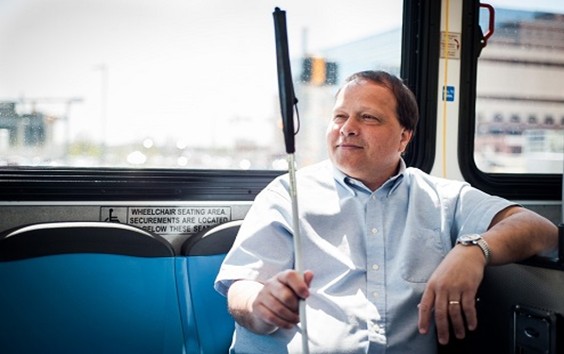
The Enhanced Mobility of Seniors and Individuals with Disabilities program (49 U.S.C. 5310) provides formula funding to states and designated recipients to meet the transportation needs of older adults and people with disabilities when the transportation service provided is unavailable, insufficient, or inappropriate to meeting these needs. Funds are apportioned based on each state’s share of the population for these two groups. Formula funds are apportioned to direct recipients: for rural and small urban areas, the state department of transportation serves this role; while in large urban areas, a designated recipient is chosen by the governor. Direct recipients have flexibility in how they select subrecipient projects for funding, but their decision process must be clearly noted in a state/program management plan. The selection process may be formula-based, competitive or discretionary, and subrecipients can include states or local government authorities, private non-profit organizations, and/or operators of public transportation.
The program aims to improve mobility for older adults and people with disabilities by removing barriers to transportation service and expanding transportation mobility options. This program supports transportation services planned, designed, and carried out to meet the transportation needs of older adults and people with disabilities in all areas – large urbanized (over 200,000), small urbanized (50,000-200,000), and rural (under 50,000).
Funding Availability and Allocation
Section 5310 funds are available for obligation for three federal fiscal years, the year of apportionment plus two additional years. For example, funds apportioned in FY 2024 are available until September 30, 2026.
FTA apportions Section 5310 funds using a statutory formula based on the number of older adults and people with disabilities in each state according to the latest U.S. Census data.
Apportionments
- FY 2025: $443,948,114
- FY 2024: $438,190,064
- FY 2023: $428,004,567
View current or archived apportionments to access detailed information.
Eligible Recipients
Direct recipients of 5310 funding include states, local government authorities, and designated recipients who then distribute funds to eligible projects and subrecipients within their areas.
Eligible subrecipients include private nonprofit organizations, state or local government authorities, and operators of public transportation. Operators of public transportation are entities that provide regular continuing shared-ride surface transportation services that are open to the general public or open to a segment of the general public defined by age, disability, or low-income. Operators of public transportation are eligible as subrecipients for nontraditional Section 5310 projects.
Eligible subrecipients should apply to the direct recipient in their area for funding. In small urban or rural areas, the direct recipient is the state department of transportation. In large urban areas the direct recipient is the designated recipient.
A federally recognized Indian tribe may apply directly to FTA for Section 5310 funds that a state, local government authority, or designated recipient has awarded to the tribe. Tribes are eligible direct recipients under the Section 5311 program.
Eligible Activities
5310 funding can be used for “traditional” or “nontraditional” projects. “Traditional” projects are capital projects as defined in 49 U.S.C. 5302(3). “Nontraditional” projects are capital and/or operating projects that go beyond the scope of the Americans with Disabilities Act (ADA) complementary paratransit services or public transportation alternatives designed to assist older adults and people with disabilities.
Traditional Section 5310 project examples include:
- Buses and vans
- Wheelchair lifts, ramps, and securement devices
- Transit-related information technology systems, including scheduling/routing/one-call systems
- Mobility management programs
- Non-emergency medical transportation
- Acquisition of transportation services under a contract, lease, or other arrangement
Nontraditional Section 5310 project examples include:
- Travel training
- Volunteer driver programs
- Construction of an accessible path to a bus stop, including curb-cuts, sidewalks, accessible pedestrian signals or other accessible features
- Improvements to signage, or way-finding technology
- Incremental cost of providing same day service or door-to-door service
- Purchase of vehicles to support new accessible taxi, rides sharing and/or vanpooling programs
- Mobility management programs
- Non-emergency medical transportation
Match
The federal share of the project costs may not exceed 80 percent for planning and capital costs and 50 percent for operating assistance. Additionally, 10 percent may be used to fund program administrative costs including administration, planning, and technical assistance may at 100-percent federal share.
Federal funds from other agencies may be used as match for the Section 5310 Program. For additional information on local match and federal fund braiding refer to the Section 5310 Circular (9070.1H) and the CCAM Federal Fund Braiding Guide.
Additional Information
FTA Guidance
To continue streamlining processes and providing high-quality customer service, FTA updated program guidance and award management requirements to incorporate provisions from the Fixing America's Surface Transportation (FAST) Act, the Infrastructure Investment and Jobs Act, the Uniform Administrative Requirements for federal awards to non-federal entities, and current FTA policies and procedures.
The Enhanced Mobility of Seniors and Individuals with Disabilities Program Guidance, C 9070.1H provides instructions and guidance on program administration and the grant application process for the Enhanced Mobility of Seniors and Individuals with Disabilities Program.
Coordination with Federal Programs
FTA’s Section 5310 program allows grantees to coordinate and assist in regularly providing meal delivery service for homebound individuals if the delivery service does not conflict with providing public transportation service or reduce service to public transportation passengers. Learn more about the Coordinating Council on Access and Mobility (CCAM).
Tribal Transportation Self-Governance Program
The Tribal Transportation Self-Governance Program (TTSGP) provides federally recognized tribes and tribal organizations with greater control, flexibility, and decision-making authority over USDOT funds used to carry out tribal transportation programs, functions, services, and activities (PFSAs) in tribal communities.
The TTSGP also affords tribes and tribal organizations with specific rights and federal resources to implement and support their Self-Governance program. Learn more about TTSGP.
Technical Assistance
The Transportation Technical Assistance Coordination Library (TACL) provides a sustainable methodology and platform to access resources across a diverse range of transportation technical assistance centers and FTA.
For additional technical assistance information and resources, visit the FTA-Sponsored Technical Assistance, Training, and Research Resource Programs webpage.