USA Banner

Official US Government Icon

Official websites use .gov
A .gov website belongs to an official government organization in the United States.

Secure Site Icon

Secure .gov websites use HTTPS
A lock ( ) or https:// means you’ve safely connected to the .gov website. Share sensitive information only on official, secure websites.

U.S. Department of Transportation U.S. Department of Transportation Icon United States Department of Transportation United States Department of Transportation

Grant Programs

Left Nav - Grant Programs
911

Fiscal Year 2020 Tribal Transit Project Selections

Click on a column header to sort by that column.

State Project Sponsor Project Description Funding AK Allakaket Village The Allakaket Village will receive funding to purchase a vehicle and initiate transit operations. This project...

Public Transportation COVID-19 Research Demonstration Grant Program

"innovation"

What's New

  • On January 19, 2021, FTA announced that 37 projects in 35 states and one territory will receive a share of approximately $15.8 million in funding. Grant recipients will receive a share of $15.8 million to support strategies that develop, deploy and demonstrate solutions that improve the operational efficiency of transit agencies and enhance rider mobility during the COVID–19 public health emergency. View the project selections.

Overview

The COVID-19 public health emergency has had a significant impact on transit operations. During a series of FTA listening sessions, transit agencies asked FTA to support research to identify solutions to address the operational challenges that they are facing as a result of COVID-19. In response, FTA announced a new $10 million FY 2020 Public Transportation COVID-19 Research Demonstration Grant Program. An additional $5.8 million in research funding was added to the program to maximize the number of states that could participate Nationwide, transit agencies are increasing the availability of service. The research and demonstration program will help evaluate, assess the efficacy, and promote promising innovative transit solutions that address challenges transit agencies are facing with the COVID-19 public health emergency.

Objectives

The COVID-19 Research Demonstration Grant Program supports strategies to develop, deploy, and demonstrate innovative solutions that improve the operational efficiency of transit agencies and enhance the mobility of transit users affected by the COVID-19 public health emergency. This new program has a specific focus on the following areas:

  • vehicle, facility, equipment and infrastructure cleaning and disinfection 
  • exposure mitigation measures
  • innovative mobility such as contactless payments
  • measures that strengthen public confidence in transit services

Selected Projects

FTA issued a Notice of Funding Opportunity (NOFO) for the COVID-19 Research Demonstration Grant Program in the fall of 2020. In response to the NOFO, FTA received 104 eligible project proposals totaling approximately $63.4 million.

On January 19, 2021, the FTA announced approximately $15.8 million in grant selections through the COVID-19 Research Demonstration Grant Program.

Statutory References

49 U.S.C. Section 5312

Allocation of Funding

The Public Transportation COVID-19 Research Demonstration Program projects are funded under FTA’s Research, Development, Demonstration and Deployment program authority.

FY 2019 Tribal Transit Program Project Selection Memo

The U.S. Department of Transportation’s (DOT) Federal Transit Administration (FTA) announces the selection of projects with Fiscal Year (FY) 2019 appropriations for the Public Transportation on Indian Reservations Program (Tribal Transit Program) and provides administrative guidance on project...

Tribal Transit Competitive Program (Section 5311(c)(1)(A))

Open road

Overview

The Public Transportation on Indian Reservations Program, also referred to as Tribal Transit Program (TTP), provides funds for planning, public transportation capital projects, operating costs, job access reverse commute projects, and the acquisition of public transportation service to tribes located in rural areas (those with a population under 50,000). TTP is funded as a takedown from the Section 5311 program, and is a set-aside from the Formula Grants for Rural Areas program that includes a formula program and a competitive grant program.

Federal public transportation law (49 U.S.C. 5311(c)(1)(A)) authorizes the competitive amount of TTP.

Tribal Transportation Self-Governance Program

The Tribal Transportation Self-Governance Program (TTSGP) provides federally recognized tribes and tribal organizations with greater control, flexibility, and decision-making authority over DOT funds used to carry out tribal transportation programs, functions, services, and activities (PFSAs) in tribal communities.

The TTSGP also affords tribes and tribal organizations with specific rights and federal resources to implement and support their Self-Governance program. Learn more about TTSGP.

Funding Availability and Allocation

Five percent of Rural Formula (Section 5311) funding is available for the Public Transportation on Indian Reservations program. 20 percent of the Public Transportation on Indian Reservations funds must be distributed on a competitive basis, while the remainder must be apportioned by formula.

Consistent with the Section 5311 program, TTP competitive funds are available for obligation for three federal fiscal years, the year of apportionment plus two additional years. For example, funds apportioned in FY 2024 are available until September 30, 2026.

FTA apportions TTP Competitive Program funds to federally recognized tribes via their respective state's Section 5311 application or awards them in a grant directly to the tribes. The funds set aside for the TTP are not meant to replace or reduce funds that tribes receive from states through the Section 5311 program but are to be used to enhance public transportation on Indian reservations and transit serving tribal communities.

Project Selections

View current or archived apportionments to access detailed information.

Eligible Recipients

Eligible recipients include federally recognized American Indian or Alaska Native tribes as identified by the U.S. Department of the Interior (DOI) Bureau of Indian Affairs (BIA).

Eligible Activities

Federally recognized tribes may use the funding for capital, operating, planning, and administrative expenses for public transit projects that meet the growing needs of rural tribal communities. All activities eligible under Section 5311 are also eligible under the TTP.

Match

No local match is required for the tribal transit competitive program, but FTA does permit a tribe to voluntarily provide match or contribute to their project with eligible matching funds.

Additional Information

Coordination with Federal Programs

FTA’s TTP allows grantees to coordinate and assist in regularly providing meal delivery service for homebound individuals, if the delivery service does not conflict with providing public transportation service or reduce service to public transportation passengers. Learn more about the Coordinating Council on Access and Mobility (CCAM).

Tribal Consultation

As part of FTA’s commitment to ensure programs and policies are responsive to the needs and concerns of Indian tribes and tribal leaders, FTA conducted a consultation and requested comments related to the TTP. Specifically, FTA consulted with tribal recipients to ensure the TTP is being administered in a beneficial manner following increases in the amount of funding available and increases in the number of tribes participating, as well as other changes related to the program.

FTA sought comments on FTA’s Tribal Transit competitive grants program and technical assistance and published Responses to Comments in June 2024.

FTA Regional Tribal Liaisons

Federal Transit Administration's Regional Tribal Liaisons

Technical Assistance

The Transportation Technical Assistance Coordination Library (TACL) provides a sustainable methodology and platform to access resources across a diverse range of transportation technical assistance centers and FTA.

For additional technical assistance information and resources, visit the FTA-Sponsored Technical Assistance, Training, and Research Resource Programs webpage.

Expedited Project Delivery Pilot Program - Section 3005(b)

What's New

  • On September 6, 2024, FTA awarded the first Full Funding Grant Agreement under the Expedited Project Delivery Pilot Program. FTA signed an $893.3 million grant agreement with the Los Angeles County Metropolitan Transportation Authority (LA Metro) to support the construction of a light rail line along busy Van Nuys Boulevard in the East San Fernando Valley. The East San Fernando Valley Transit Corridor Phase I project (the Project) will improve mobility with a north-south connection between the communities of Van Nuys, Panorama City, Arleta, and Pacoima. The Project includes 11 stations, 33 light rail vehicles, and extensive street and sidewalk improvements along the route. The new light rail line will also link to LA Metro’s bus rapid transit G line (Orange), Amtrak, and the Metrolink Ventura County Line.

Overview

The EPD Pilot Program, authorized by Section 3005(b) of the Fixing America’s Surface Transportation Act (FAST Act), is aimed at expediting delivery of new fixed guideway capital projects, small starts projects, or core capacity improvement projects. These projects must utilize public-private partnerships, be operated and maintained by employees of an existing public transportation provider, and have a federal share not exceeding 25 percent of the project cost. FTA will notify applicants in writing within 120 days after the receipt of a complete application whether the application has been approved.

On July 28, 2020, FTA announced a Notice of Funding Opportunity for the Expedited Project Delivery (EPD) Pilot Program. Applications will be accepted on a rolling basis until up to eight grants are awarded, subject to funding availability.

On Wednesday, August 26, 2020, FTA hosted a webinar to provide information on the EPD Pilot Program.

View the presentationListen to the recording | Read the transcript

Applicants must use the EPD Pilot Program application.

Objectives

The EPD Pilot Program streamlines project delivery of new transit infrastructure that meets program requirements. It encourages innovative partnerships and funding so projects can be completed more quickly.

Eligible Projects

Eligible projects are new fixed guideway capital projects, small start projects, or core capacity improvement projects that have not entered into a full funding grant agreement with FTA. The law defines these types of eligible projects for the EPD Pilot Program in a manner similar to, but not entirely the same as, FTA’s Capital Investment Grants (CIG) program. Applicants should therefore read the NOFO carefully to understand the EPD Pilot Program project eligibility. New fixed guideway capital projects or small start projects may include the acquisition of real property, the initial acquisition of rolling stock for the system, the acquisition of right-of-way, and relocation. Core capacity improvement projects may include the acquisition of real property, the acquisition of rights-of-way, double tracking, signalization improvements, electrification, expanding system platforms, acquisition of rolling stock associated with corridor improvements increasing capacity, construction of infill stations, and such other capacity improvements as FTA determines are appropriate to increase the capacity of an existing fixed guideway system corridor by not less than 10 percent.

Eligible Recipients

State or local government authorities who must demonstrate:

  • Legal, financial, and technical capacities to carry out the eligible project, including the safety and security aspects of the eligible project;
  • Satisfactory continuing control over the use of the equipment or facilities;
  • The technical and financial capacity to maintain new and existing equipment and facilities;
  • That they have qualified advisors providing guidance on the terms and structure of the project who are independent from investors in the project; and
  • That the existing public transportation system is in a state of good repair.
    • This requirement may be waived by FTA if the project meets the definition of a core capacity improvement project, and FTA determines that the eligible project will allow the applicant to make substantial progress in achieving a state of good repair.

Application and Selection Process

FTA provides technical assistance to potential grant applicants including working with them to understand the program requirements and develop a complete application package. Per the NOFO, the complete applications must be submitted electronically via FTA’s EPD Pilot Program secure application submission site and must include responses to all sections, forms, and attachments, unless indicated as optional. Only the information submitted to the application site will be used to determine the applicant and project eligibility for the EPD Pilot Program and to evaluate the proposal against the criteria described in the NOFO.

Once an application is submitted, FTA will review the completeness of the application. This is a high-level review to determine if any requested information is missing or incomplete. If the submitted application is missing requirements, or requirements are not complete, then the application will be denied, and therefore not progress to the next phase. The project sponsor may resubmit their application once they believe they have addressed the incomplete item(s), per the NOFO.

An application that is deemed complete will advance to the 120-day statutory review phase, which includes a detailed review of the application and coordination with the Office of the Secretary of Transportation for their consideration of FTA’s recommended action. During this phase, FTA will hold regularly scheduled meetings with the applicant to exchange feedback, gain clarifications on any issues or concerns, request updated documentation and discuss the progress of the application. Within 120 days, FTA will notify the project sponsor with one of the following:

  • Selected/Approval for a:
    • Full Funding Grant Agreement (FFGA): The development of an FFGA will be recommended if the project sponsor’s application fully meets the eligibility requirements in the NOFO. With the FFGA, FTA commits to a specific dollar amount of EPD Pilot Program funding for the project scope as presented in the project sponsor’s application, and contingent on the availability of funding. Congressional notice will be given 30 days in advance of issuing an FFGA.
    • Letter of Intent (LOI): If certain conditions have not been met for an application deemed worthy of selection, FTA will issue a LOI. A LOI contains a list of conditions that have been identified from FTA’s review of the project sponsor’s application. Once the LOI conditions are met, the project can be considered for a FFGA. With a LOI, FTA commits to a specific dollar amount of EPD Pilot Program funding for the project scope as presented in the project sponsor’s application, and contingent on the availability of funding. A LOI and its commitment of federal funding will expire after two years if conditions are not met. Congressional notice will be given 30 days in advance of issuing a LOI. If the project advances to the development of an FFGA, FTA will provide a second congressional notice 30 days before the award of the grant agreement.
  • Not Selected/Disapproval: If the application does not meet the requirements of the NOFO, FTA’s written notice will include a detailed explanation of the reasons for the disapproval.
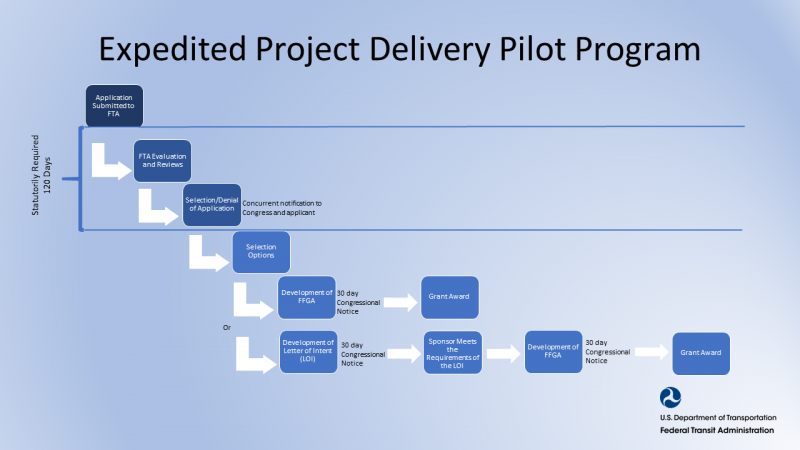
Expedited Project Delivery (EPD) Pilot Program Process Schedule

Match

The federal share of project costs under this program is limited to 25 percent.

Disclaimer

The contents of this page do not have the force and effect of law and are not meant to bind the public in any way. This guidance is intended only to provide clarity to the public regarding existing requirements under the law or agency policies. Grantees and subgrantees should refer to FTA’s statutes and Notice of Funding Opportunity (NOFO) for applicable requirements of the EPD Pilot Program.