


Grant Programs
911
All Stations Accessibility Program FY22-23 Projects
Click on a column header to sort by that column.
State Project Sponsor Project Description Funding CT Connecticut Department of Transportation The Connecticut Department of Transportation will receive funding to retrofit three...Fiscal Year 2022 Transit-Oriented Development (TOD) Planning Projects
State Project Sponsor Project Description Amount AL Birmingham-Jefferson County Transit Authority The Birmingham-Jefferson County Transit Authority will receive funding to plan for TOD at the eastern end of the new Birmingham Xpress bus rapid...Competitive Grants for Rail Vehicle Replacement Program (Rail Program) Webinar
This file is the PDF of slides from the informational webinar presentation for potential applicants to the FY 2022-2023 Competitive Grants for Rail Vehicle Replacement Program (Rail Program). The webinar material covers the application requirements and how to apply through Grants.gov.
...
Fiscal Year 2022 Project Selections and Implementation Guidance for the Tribal Transit Competitive Program
This document provides a listing of the FY22 Tribal Transit Competitive Program project selections and discretionary IDs associated with the grant awards. It also includes guidance and administrative requirements related to the Tribal Transit Competitive Program.
Expedited Project Delivery Pilot Program Standard Cost Category Workbooks
Applications for the Expedited Project Delivery (EPD) Pilot Program must include an EPD Standard Cost Category (SCC) Workbook.
FTA’s Standard Cost Categories establish a consistent format for the reporting, estimating, and managing of capital costs. The SCC Workbook is a project...
Rail Vehicle Replacement Grants
Overview
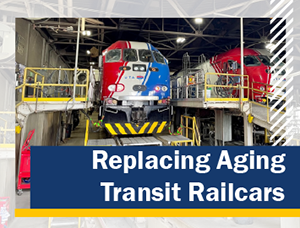
The Rail Vehicle Replacement Program makes funding available competitively to help fund capital projects to replace rail rolling stock. For the purposes of this program, rail rolling stock is defined as revenue service, passenger carrying vehicles, or propulsion (locomotives) vehicles necessary for the provision of rail public transportation. The program is a set-aside of the State of Good Repair Formula Grants Program (49 U.S.C. 5337).
Eligible Recipients
Eligible recipients are state and local government authorities in urbanized areas (UZAs) that are eligible for State of Good Repair Formula Funding (Section 5337).
Eligible Activities
Eligible activities are the replacement of rail rolling stock. For the purposes of this program, rail rolling stock is defined as revenue service, passenger carrying vehicles, or propulsion (locomotives) vehicles necessary for the provision of rail public transportation. Funded capital projects must be in an agency’s Transit Asset Management (TAM) plan, according to 49 CFR 625.
Statutory Reference
49 U.S.C. 5337 / Infrastructure Investment and Jobs Act (Bipartisan Infrastructure Law), §30016
Match
The federal share is not to exceed 80 percent of the net project cost. The maximum share of the grant funding cannot exceed 50 percent of the net project cost.
For example, a rail vehicle replacement project with a total eligible cost of $100,000,000 may receive up to $50,000,000 from this program. The remaining $50,000,000 could be provided from a combination of non-Federal and other Federal funds, up to $30,000,000 of which could be other Federal funding. For a $100,000,000 project, at least $20,000,000 (20-percent) must be non-Federal funds.
Selected Projects
Fiscal Year 2022 Tribal Transit Project Selections
Click on a column header to sort by that column.
State Project Sponsor Project Description Funding AK Emmonak Village The Emmonak Village will receive funding to develop a transit plan. The plan will improve access to and within...Advanced Driver Assistance Systems (ADAS) for Transit Buses Demonstration and Automated Transit Bus Maintenance and Yard Operations Demonstration Program
What's New
- On June 8 , 2023, FTA announced $11.6 million to six projects to research automation technologies to improve safety and efficiency in bus service and yard operations.
- On September 22, 2022, FTA announced a Notice of Funding Opportunity (NOFO) to solicit proposals from organizations interested in advancing research into transit bus automation through demonstrations of Advanced Driver Assistance Systems (ADAS) and automation of bus movements in transit bus yards. The demonstration projects will help determine potential benefits, costs, and other impacts of transit bus automation. The demonstration projects will also provide transit agencies with resources, guidance, and tools to make informed deployment decisions.
Overview
The Transit Bus Automation Research program provides $5 million for ADAS for Transit Buses demonstrations to help improve transit bus safety and efficiency. Another $1.5 million for an initial phase of Automated Transit Bus Maintenance and Yard Operations demonstrations is available to improve worker efficiency and safety in bus yards.
As part of FTA’s Strategic Transit Automation Research (STAR) Plan, the projects will demonstrate transit bus automation technologies in real-world settings, help establish the feasibility of deploying ADAS and Automated Transit Bus Maintenance and Yard Operations, and improve understanding of the impacts, including transit workforce impacts. Additional information may be found on FTA’s Transit Automation Research webpage.
Eligible Projects
Eligible activities for the ADAS for Transit Buses Demonstration include engineering activities leading to the demonstration of ADAS use cases, such as requirements, architecture, and design development; equipment installation and integration; and pre-demonstration testing. Workforce engagement, training, and skills development activities related to the demonstration are also eligible. Projects will consist of a 12-month minimum for operational demonstration in revenue service. Eligible projects must propose to demonstrate at least one ADAS use case.
Eligible activities for the Automation for Maintenance and Yard Operations Demonstration include applicable systems engineering activities leading to the proof-of-concept demonstration, such as requirements, architecture, and design development; equipment installation and integration; and testing. Workforce engagement, training, and skills development activities related to the demonstration are also eligible.
Eligible Applicants
Eligible applicants under this NOFO include the following:
- Public transit agencies
- State/local government entities
- Metropolitan planning organizations (MPOs)
- Federally recognized Indian tribes
- Institutions of higher education, particularly those with Minority Serving Institution status
Applications must clearly identify the eligible applicant and all project partners on the project team. Eligible project partners under this program may include, but are not limited to:
- Bus manufacturers
- Technology system suppliers, developers, and integrators
- Operators of transportation services, such as employee shuttle services, airport connector services, university transportation systems, or parking and tolling authorities
- State or local government entities
- Labor unions and other workforce representatives
- Other organizations, including consultants, research consortia, and not-for-profit industry organizations
In the application, eligible applicants are encouraged to identify one or more project partners with a substantial interest and involvement in the project activities or objectives to participate in the implementation of the project.
If an application that involves such a partnership is selected for funding, the competitive selection process will be deemed to satisfy the requirement for a competitive procurement under 49 U.S.C. 5325(a) for the named entities. Applicants are advised that any changes from the proposed partnership after selection will require FTA’s written approval, must be consistent with the scope of the approved project, and may require competitive procurement unless an exception applies.
To be considered eligible, applicants must be able to demonstrate the requisite legal, financial, and technical capabilities to receive and administer Federal funds under this program.
Statutory Reference
Federal public transportation law (49 U.S.C. 5312) authorizes FTA’s Public Transportation Innovation Program. Through this program, FTA may support research, development, demonstration, and deployment projects, and evaluation of research and technology of national significance to public transportation that the Secretary determines will improve public transportation service.
Allocation of Funding
Up to $6.5 million is available for demonstration projects, including $5 million for ADAS for Transit Buses and $1.5 million for an initial phase of Automated Transit Bus Maintenance and Yard Operations. Subject to availability, additional funding may be provided to implement a second phase of the Automated Transit Bus Maintenance and Yard Operations Demonstration. The ADAS for Transit Buses Demonstration and Automated Transit Bus Maintenance and Yard Operations Demonstration Competitive Funding Opportunity is funded under FTA’s Research, Development, Demonstration, and Deployment Program authority.
Match
The maximum Federal share of project costs under this program is limited to 80 percent. Applicants may seek a lower Federal contribution. The applicant must provide the non-Federal share of the net project cost in cash, or in-kind, and must document in its application the source of the non-Federal match. Eligible sources of non-Federal match are detailed in FTA Circular 6100.1E.
Community Project Funding/Congressionally Directed Spending
What’s New
The Consolidated Appropriations Act, 2026 (Public Law 119-75) appropriated approximately $148 million in Transit Infrastructure Grants for Community Project Funding (CPF), also known as Congressionally Directed Spending (CDS).
Overview
CPF is appropriated and allocated from the General Fund for Transit Infrastructure Grants only on an annual basis and at the discretion of Congress. The total funding amounts are specified in the Consolidated Appropriations Act corresponding with each fiscal year, if applicable. The list of projects are found in the accompanying Joint Explanatory Statement.
Eligible Recipients
CPF recipients and their allocations are determined by Congress. All recipients are specifically identified in the Appropriations Act corresponding with the applicable fiscal year.
Eligible Activities
Expenses for these projects that are eligible under FTA’s authorizing language in federal law (Chapter 53 of Title 49, United States Code) are eligible for reimbursement.
Match
Fiscal year 2023, 2024 and 2026 CPF grants are available at up to an 80 percent federal share. Fiscal year 2022 CPF grants are funded at 100 percent federal share, as Congress did not specify a local match requirement.
Statutory Reference
- Consolidated Appropriations Act, 2026 (Public Law 119-75)
- Consolidated Appropriations Act, 2024 (Public Law 118-42)
- Consolidated Appropriations Act, 2023 (Public Law 117-328)
- Consolidated Appropriations Act, 2022 (Public Law 117-103)
Projects
The current year CPF allocations (Apportionment Table 20) and the prior year unobligated allocations (Apportionment Table 21) are updated annually and posted on Current Apportionments. The following amounts have currently been appropriated to date:
- Consolidated Appropriations Act, 2026 (Pub. L. 119-75, 2023): $147,923,390
- Consolidated Appropriations Act, 2024 (Pub. L. 118-42, 2024): $206,817,976
- Consolidated Appropriations Act, 2023 (Pub. L. 117-328, 2022): $360,459,324
- Consolidated Appropriations Act, 2022 (Pub. L. 117-103, 2022): $200,798,267