
USA Banner

Official US Government Icon

Official websites use .gov
A .gov website belongs to an official government organization in the United States.

Secure Site Icon

Secure .gov websites use HTTPS
A lock ( ) or https:// means you’ve safely connected to the .gov website. Share sensitive information only on official, secure websites.

U.S. Department of Transportation U.S. Department of Transportation Icon United States Department of Transportation United States Department of Transportation

Competitive

Transit Cooperative Research Program - 5312(i)

Program Overview

The Transit Cooperative Research Program (49 U.S.C. 5313; TCRP) is an applied, contract research program that develops near-term, practical solutions to problems facing transit agencies. TCRP, promotes operating effectiveness and efficiency in the public transportation industry by conducting research designed to solve operational problems, adopt useful technologies from related industries and introduce innovation that provides better customer service. The industry-driven program serves as one of the principal means by which the transit industry can develop innovative short-term solutions to meet demands placed on it.

TCRP products, such as transit security guidelines, new transit paradigms, transit industry best practices, exploratory idea transit practice and testing prototypes, and new planning and management tools, as well as, rail and bus certification programs, all help develop and equip a quality transit workforce to meet new challenges and opportunities.

  • The Transportation Research Board (TRB), which administers the TCRP, maintains an electronic database of all TCRP publications and project descriptions. 
  • TCRP reports are available online at the TCRP Dissemination website maintained by the American Public Transportation Association.

TCRP is sponsored by FTA and carried out under a three-way agreement among the National Academy of Sciences, acting through the Transportation Research Board; the Transit Development Corporation, Inc., the educational and research component of the American Public Transportation Association; and FTA. Funds for projects are allocated by transit industry consensus through TRB.

Research problem statements are solicited annually from the transit community. TRB publishes competitive contracts for research and synthesis studies of current best practices. The TCRP Oversight and Project Selection (TOPS) Committee selects the highest priority problems to be addressed and designates funds for conducting the research.

The TCRP focuses on research that is consistent with, and supportive of, FTA’s strategic research goals and policy initiatives.  The research fields for TCRP consist of planning, service configuration, equipment, facilities, operations, human resources, maintenance, policy, and administrative practices.

Statutory References

49 U.S.C. Section 5312(i)

Funding Availability

Funds are allocated on an annual basis.

Allocation of Funding

Funds for this program are congressionally mandated.

Match

There is no matching requirement.

Other Program Highlights

Each project selected by the TOPS Committee for funding is assigned to a technical panel that provides technical guidance and counsel throughout the life of the project. Panels include experienced practitioners and research specialists, with emphasis placed on including members representing the intended consumers of the research product. The panels prepare project statements and select contractors based on evaluation of the proposals received.

The program, Ideas Deserving Exploratory Analysis (IDEA), is steered by the TCRP J-4 panel of transit industry professionals that support FTA strategic priorities and initiatives. Proposals are selected competitively. The IDEA proposals differ from other project proposals because these projects can be funded to develop and test the feasibility of new and innovative concepts and methods for advancing transit.  

There program entitled "Legal Studies" is conducted by the J-5 panel comprised of professional transit attorneys.  Proposals are selected competitively. Ideas for study topics can be submitted by anyone.  The Legal Studies Program is focused on legal issues relevant to the transit industry and intended to provide transit attorneys with authoritative, well-research, specific information. The TCRP Legal Research Digest series reports produced from this program focuses on legal issues and problems having national significance to the transit industry. 
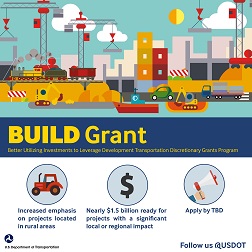
Better Utilizing Investments to Leverage Development (BUILD) Transportation Grants Program (formerly TIGER)

Build Grant Graphic.U.S. DOT’s Better Utilizing Investments to Leverage Development (BUILD) Transportation Discretionary Grants program funds investments in transportation infrastructure, including transit. BUILD Transportation grants replace the Transportation Investment Generating Economic Recovery (TIGER) grant program. Learn more about FY 2018 BUILD Transportation grants.

FTA acts as the administering modal agency for BUILD projects that directly impact public transportation. FTA helps to ensure that recipients have the technical assistance and support necessary to successfully complete their projects throughout the development and implementation process.

Previously,  the TIGER program funded eight rounds of transportation-focused, economic-generating projects in communities across the country. Between 2009 and 2017, the TIGER grant program provided $5.1 billion to 421 projects in all 50 states, the District of Columbia, Puerto Rico, Guam, the Virgin Islands, and tribal communities. See grant agreement information, including required exhibits.

Zero Emission Research Opportunity (ZERO)

On November 22, 2016, FTA announced the opportunity for nonprofit organizations to apply for funding to conduct research, demonstrations, testing, and evaluation of zero emission and related technology for public transportation applications. The deadline for applications is February 21, 2017. Questions? See our ZERO Program FAQs.

Overview

Since 2008, FTA has provided more than $150 million to support the research, development and deployment of cleaner, more efficient public transit vehicles. FTA's Low and No Emission (Low-No) Vehicle Deployment Program has proven the interest of transit agencies to procure and operate innovative and efficient models, including battery electric and hydrogen fuel cell buses. The purpose of ZERO is to support the industry as it examines the potential of larger fleets and improved vehicles.  

In implementing ZERO, FTA will use a cooperative research model similar to FTA’s successful National Fuel Cell Bus Program. Under this model, research and demonstration projects are defined and conducted by pre-selected non-profit consortia that, under FTA direction, assemble and manage project teams. Teams, comprised of transit agencies, vendors, suppliers, and others, will introduce an enhanced level of research management, program continuity, and flexibility to federally funded transit research. Through ZERO, FTA seeks to create a research environment that results in greater industry involvement and more innovative and successful projects.

FTA intends to enter into cooperative agreements with up to three nonprofit consortia. Eligibility for future ZERO funding opportunities in fiscal years 2017-2020 will be limited to those nonprofit consortia selected under the initial fiscal year 2017 notice. Potential research partners such as transit agencies, other nonprofits, vendors, suppliers and systems integrators may work with multiple consortia.

Objective

FTA’s objective for ZERO is to work with the public transportation industry to solve challenges, increase efficiency, and reduce the costs and risks of deploying zero-emission vehicles in transit service.

Eligible Activities

Eligible activities and projects include research, innovation and development, demonstration, deployment, and evaluation. These areas are defined under 49 U.S.C. Section 5312(c), (d), and (e). Projects will build on successful research, innovation, and development to facilitate the deployment of low- or no-emission vehicles, zero-emission vehicles, or associated advanced technology.

Eligible Recipients

Eligible applicants and recipients under this program are limited to nonprofit organizations leading a consortium of entities. All consortia must include at least one provider of public transportation. The following entities may be part of a consortium:

  • Departments, agencies, and instrumentalities of the Federal Government, including federal laboratories;
  • State and local governmental entities;
  • Providers of public transportation;
  • Private or nonprofit organizations;
  • Institutions of higher education; and
  • Technical and community colleges.

If future funding becomes available, the selected nonprofit organization(s) will have the opportunity to compete for future project funding for the duration of the FAST Act authorization – through fiscal year 2020. 

Statutory References

49 U.S.C. 5312

Allocation of Funding

$2.75 million initially. Additional funding may be provided in FY17-FY20, subject to appropriations  and FTA discretion.

Match

Local match (or share) is required.  FTA share may not exceed 80 percent of project costs.

Public Transportation Innovation - 5312

Program Overview

Provides funding to develop innovative products and services assisting transit agencies in better meeting the needs of their customers. 

Eligible Recipients

Eligible recipients are determined for each competition, and may include: universities, public transportation systems, state DOTs, non-profit and for-profit entities, amongst others.

Funding Opportunities

Funds may be allocated on a discretionary basis. Grant opportunities are posted on http://www.grants.gov/ under the CFDA Number 20.514. Interested parties may subscribe on that website to receive notification of all FTA research opportunities by entering 20.514 where it requests the CFDA Number.

Eligible Activities

Research, development, demonstration and deployment projects, and evaluation of technology of national significance to public transportation.

Research Grant Program Requirements

FTA Research, Technical Assistance and Training Program Requirements

Additional information

Research & Technology

Grant Authorization

49 U.S.C. 5312